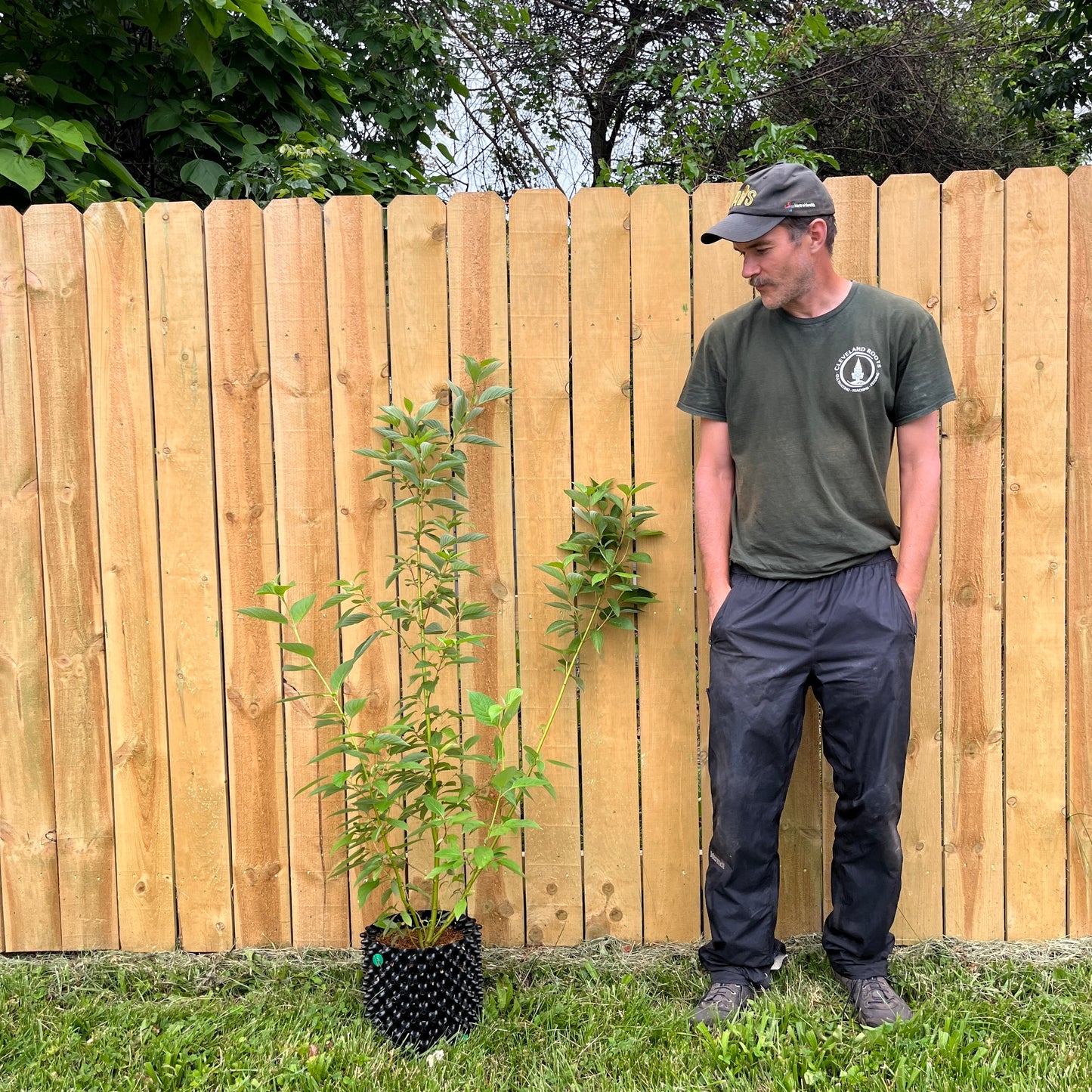
Red osier dogwood
Cornus sericea
Cornus sericea
5 remaining
Couldn't load pickup availability
Sun/shade: Full sun to part shade
Soil moisture: Dry to wet
Height: 6-9'
Flowering period: May
Deer resistance: Medium
Return your shrub pots for a cash rebate! Get $8 for each #3 or #5 container, and $5 for each #1 or #2 container. Learn more.
Red Osier dogwood’s stems turn brilliant red in the fall, providing unmatched color that lasts through the winter. In May, clusters of white blooms are a resource to bees, and if these flowers receive pollen from a second red osier dogwood, they’ll produce white berries beloved by birds.
In natural areas, red osier dogwood is primarily a wetland species, growing in swamps, marshes, and along river and pond margins. It is an early colonizer of wet, open ground, and it will persist in the forest understory to a limited extent after such ground becomes dominated by trees. Most abundant in moist habitats, red osier dogwood can also be found in lower numbers in dry upland environments.
In the home landscape, red osier dogwood likes full to partial sunlight and soil of wet to average moisture. Although it can survive in the shade, this shrub will be taller and fuller, displaying better shape in the sun. In shady locations the shrub assumes a less upright form, and where its branches contact the ground surface, they root and creep away from the mother plant, forming new shrubs. This type of spreading is called layering and usually does not occur in full sun for this species. Red osier dogwood grows well in consistently damp soil and has good tolerance for periodic flooding. Once established, though, it can handle drier conditions, including droughts.
Red osier dogwood’s wide moisture adaptability makes it a great choice for rain gardens, which often fluctuate from wet to dry depending on rainfall amounts. In general, the plant’s excellent ornamental and wildlife attributes are useful in both formal and habitat-focused plantings. Placing multiple shrubs in a front bed or hedgerow enhances the effect of their red stems in winter. This arrangement also allows for cross pollination to occur when the shrubs are in bloom, leading to berry production. Red osier dogwood will not produce berries when planted as a lone plant. Finally, this shrub is highly recommended for stabilizing streambanks and preventing erosion.
Maintenance of red osier dogwood consists of protection against deer browse while the shrub is getting established and regular pruning as desired. Deer will eat red osier twigs and prevent the shrub from filling out. Gardeners should cage the shrub for at least one year until it attains a desirable size. At that point the cage can be removed and deer impact should be minimal. Red osier dogwood is a large shrub, with a mature height and spread of up to 9’. Regular pruning can keep red osier dogwood at a more moderate size and will increase the number of young stems, which display the brightest winter color. Pruning can be accomplished in two ways: annual removal of one third of the plant’s stems, focusing on the oldest ones, or cutting the entire shrub down to a 9” height every third year.
Pruning for red osier dogwood is often done in early spring, because this allows one to get a clear view of the plant’s stems. However, pruning at this time will remove flower buds, diminishing the plant’s bloom. Pruning immediately after the plant blooms in the spring avoids this drawback.
In terms of wildlife benefit, red osier dogwood is a very valuable shrub. Its flowers are attractive to a wide variety of springtime pollinators, especially spring mining bees. The shrub’s berries are quite nutritious and energy dense, with a fat content of 23%. High-fat berries are desired by migratory songbirds seeking foods to fuel their long-distance flight. Red osier dogwood twigs are also a favorite nest site for goldfinches.
Photo 1 © bobl2, CC BY-NC 4.0. Photo 2 © Andreas Ranner, CC BY-NC 4.0. Photo 3 © Lorie Shaull, CC BY 2.0.